Table of Contents
- Why Immersive Leadership Workshops Beat Traditional Training
- Core Leadership Workshop Topics That Drive Real Change
- High-Impact Leadership Training Activities and Simulations
- How Leadership Simulation Training Builds Decision-Making Under Pressure
- Leadership Workshop Evaluation: Measuring ROI and Skill Transfer
- Accessibility, Psychological Safety, and Inclusion in Immersive Learning
- Frequently Asked Questions
Last Updated: October 10, 2026
Why Immersive Leadership Workshops Beat Traditional Training
The benefits of immersive leadership workshops come down to one thing: people do not change how they lead by listening to a lecture. They change by making decisions under pressure and living with the consequences in a controlled setting. At Echo Sierra Tactical, we build that pressure deliberately, using realistic training cells and optional live opposition forces so teams practice the exact skills that fall apart in a conference room. Traditional programs teach leadership as a subject. Immersive leadership training treats it as a physical skill that has to be rehearsed.
The Problem With Lecture-Based Leadership Development
Most corporate leadership development fails for a structural reason, not a motivational one. Sitting in a lecture hall or clicking through a video module asks learners to absorb abstract frameworks and apply them later, in a moment they cannot rehearse. When a real conflict or crisis arrives, that stored knowledge rarely surfaces.
A common mistake is measuring attendance instead of behavior. A team can finish a twelve-week program, earn certificates, and still communicate exactly as it did before. The missing ingredient is consequence. Immersive learning introduces a scenario where a bad call produces a visible, immediate result, and that feedback loop is what makes the lesson stick.
Core Leadership Workshop Topics That Drive Real Change
The leadership workshop topics that actually move behavior cluster around a few competencies: communication, conflict resolution, and executive presence. These are the skills that decide whether a team functions when the plan breaks, and they are exactly the skills that are hardest to teach from a slide deck.
Communication, Conflict Resolution, and Executive Presence
Communication is the ability to transmit intent clearly when conditions are noisy and time is short. Conflict resolution is the discipline of de-escalating friction before it consumes the mission. Executive presence is the steadiness that makes a team trust its leader when the outcome is uncertain.
In an immersive setting, these stop being concepts. A participant has to give a direction that others can act on immediately. They have to read a tense exchange and defuse it. They have to hold composure while the scenario escalates. Because these moments are rehearsed rather than imagined, the behavior transfers to the workplace, where the same pressures appear in slower motion.
High-Impact Leadership Training Activities and Simulations
The most effective leadership training activities are scenario-based and require the whole team to participate, not just observe. Simulation, role-playing, and hands-on practice replace passive listening, which is why engagement and retention rise together. A well-designed activity forces every person into a decision, then makes the result of that decision visible.
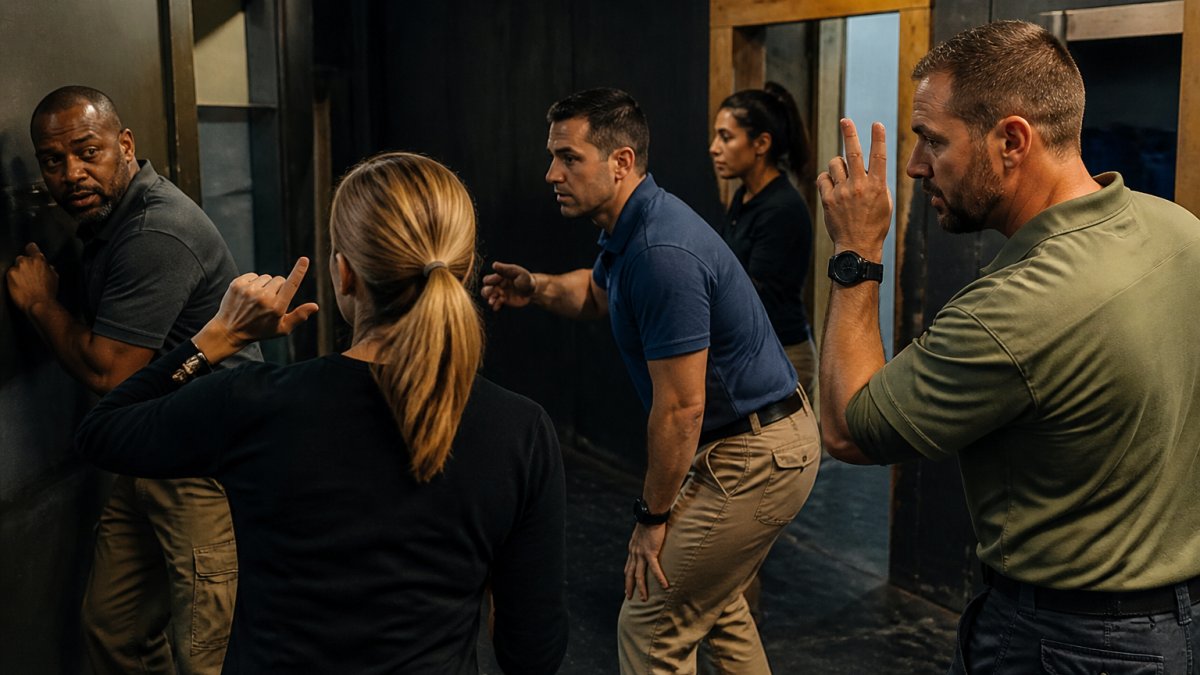
Common formats that work:
- Crisis simulation: a time-bound problem with incomplete information and a moving objective
- Role-playing: participants take on unfamiliar roles to expose blind spots in how they lead
- Hands-on decision drills: rapid choices with immediate, visible consequences
- Structured debriefs: a facilitated review that turns the experience into a lesson
The debrief matters as much as the exercise. Without reflection and feedback, an intense activity is just adrenaline. With it, the experience becomes a coaching moment the team can act on.
How Leadership Simulation Training Builds Decision-Making Under Pressure
Leadership simulation training builds decision-making under pressure by recreating the conditions that cause it to fail, then letting people practice recovering. Stress narrows attention and slows judgment. A realistic scenario exposes that response in a safe environment, where a wrong call costs nothing but teaches everything.
This is where the design of the scenario matters. Too easy, and it reinforces bad habits. Too chaotic, and participants shut down. The goal is calibrated stress: enough to force real decisions, not so much that learning stops. Optional live opposition forces raise that calibration, because a thinking opponent creates the unpredictability that a scripted exercise cannot.
Leadership Workshop Evaluation: Measuring ROI and Skill Transfer
Most competitors describe evaluation as a post-workshop survey. That is the weakest possible measure, and it is why so many leadership programs cannot defend their budget. Real evaluation starts before the workshop, runs on a defined timeline, and ends with a business outcome the organization already tracks.
A practical evaluation framework, mapped to a 90-day window:
- Define the behavior (pre-workshop). Name the specific skill, such as giving clear direction under time pressure, and describe what it looks like when done well.
- Capture a baseline (pre-workshop). Use a manager observation rubric, a short team survey, or an existing performance metric. Without a baseline, you cannot show change.
- Measure reaction and learning (day of). Gather immediate feedback and a brief knowledge or scenario check. This is the weakest tier of evidence, treat it as a gate, not a result.
- Measure behavior change (30 to 90 days). Re-observe the same behavior with the same rubric. Ask managers to log specific examples. This is where most programs quietly fail, because no one follows up.
- Measure results (60 to 180 days). Tie the change to a business or team outcome you already track, retention on the team, project cycle time, escalation volume, or customer satisfaction scores.
A common pattern is that motivation spikes on day one and decays within two to three weeks without reinforcement. Plan the reinforcement before you book the workshop:
- Pre-work: a short reading, a self-assessment, or a baseline scenario so participants arrive with context.
- Manager briefing: a 15-minute conversation before the session so the manager knows what behavior to watch for afterward.
- 30-day refresher: a short virtual scenario or a team debrief that revisits the target skill.
- 60-day practice: a second scenario, ideally with a different twist, so the skill generalizes.
- 90-day review: a structured check against the baseline rubric, with the manager and the participant.
Attribution deserves an honest caveat. Leadership behavior is influenced by many factors, so a single workshop rarely owns a business outcome outright. The defensible approach is to define the behavior, measure it directly, and show the trend alongside the business metric, not to claim the workshop caused a revenue change on its own.
Accessibility, Psychological Safety, and Inclusion in Immersive Learning
Psychological safety is the foundation that makes immersive learning work. Participants have to know that a wrong decision in a scenario is a learning moment, not a performance review. Without that, people play it safe, and safe play teaches nothing.
Inclusion and accessibility require deliberate design. Teams include people with different fitness levels, different anxiety thresholds, and different physical abilities. A well-built program offers roles that do not depend on physical exertion, clear opt-in boundaries, and a facilitator who watches for distress and adjusts. Intensity should be a dial, not a switch.
Safety and logistics deserve a straight answer up front. Ask any provider how scenarios are supervised, what participants are asked to sign, and how the facility handles a participant who wants to stop. A disciplined environment is one where the rules are clear before anyone steps into the room.
Leadership teams face pressure every day, and the gap between knowing the right move and making it under stress is where most development programs fall short.
Frequently Asked Questions
What are the benefits of immersive leadership workshops?
Immersive leadership workshops build skills that stick because participants practice under realistic pressure rather than discussing theory. Teams develop stronger communication, faster decision-making, and emotional intelligence through hands-on scenarios. Research on experiential learning shows that adults retain far more when they apply skills immediately. Participants also build trust with each other, which carries back to the workplace. Unlike a lecture, an immersive workshop forces every person to contribute, listen, and adapt in real time.
How do simulations help develop leadership skills?
Leadership simulation training puts people in realistic scenarios where they must make decisions with incomplete information and limited time. This mirrors what actually happens on the job. Simulations surface default behaviors, like who speaks up, who freezes, and who takes charge, giving facilitators concrete moments to coach. Because there are no real consequences, participants can fail safely and try a different approach. Repeated simulation practice builds the muscle memory that transfers to high-stakes situations at work.
How can you measure the effectiveness of a leadership workshop?
Start with pre-workshop surveys that capture how participants rate their own communication and decision-making. After the session, use facilitator observations, peer feedback, and a post-workshop assessment to compare. Then track workplace behavior over 30, 60, and 90 days: meeting participation, conflict resolution speed, and manager feedback. Leadership workshop evaluation works best when you define the specific behaviors you want to change before the session, not after. Pair qualitative feedback with any hard metrics your team already tracks.
Are immersive leadership workshops better than traditional training?
For skill development, immersive formats generally outperform lectures because participants practice rather than observe. Traditional training works well for delivering frameworks and background knowledge. Immersive workshops work better for building communication, decision-making, and composure under stress. Many organizations combine both: pre-work reading or video modules, then an in-person immersive session where the real learning happens. The right choice depends on what you need: awareness or capability.