Table of Contents
- Step 1: Diagnose How Your Team Communicates Now
- Step 2: Build Active Listening in the Workplace
- Step 3: Set Team Communication Strategies That Fit the Work
- Step 4: Run Team Communication Exercises That Transfer to Real Work
- Step 5: Give and Receive Constructive Feedback Without Defensiveness
- Step 6: Measure Progress With Communication KPIs
- Step 7: Invest in Communication Skills Training for Teams
- Frequently Asked Questions
Last Updated: October 6, 2026
Step 1: Diagnose How Your Team Communicates Now
You cannot fix what you have not measured. Learning how to improve team communication skills starts with a clear baseline of how your team talks, listens, and shares information today.
Most workplace communication problems are not attitude problems. They are habits nobody has ever examined.
Run a 10-Minute Communication Audit
A communication audit is a short, structured review of how information moves through your team.
Set aside ten minutes at your next team meeting. Ask each person three questions:
- Where do you get your tasks from most days?
- What information reaches you too late?
- Which meetings could be an email instead?
Write the answers on a whiteboard. Patterns show up fast. According to Gallup’s workplace research on team engagement, teams with clear communication report far higher engagement than teams left guessing.
Run this audit quarterly, not once. Communication habits drift when workloads spike, and a ten-minute check catches the drift before it becomes a crisis.
Step 2: Build Active Listening in the Workplace
Active listening in the workplace is the practice of fully concentrating on what a speaker says, then confirming you understood it before you respond.
It sounds basic. It is also the skill most teams skip.
The 3-Second Rule and Paraphrase Check
Two habits fix most listening failures.
The 3-second rule: Wait three full seconds after someone finishes before you speak. This tiny pause stops you from cutting people off and gives quiet team members room to join.
The paraphrase check: Repeat the request back in your own words. “So you need the draft by Thursday, not Friday. Right?” One sentence prevents days of rework.
Skipping the paraphrase check is the most common cause of task rework. Teams that assume they understood a request often deliver the wrong thing entirely, then repeat the whole cycle.
Step 3: Set Team Communication Strategies That Fit the Work
Team communication strategies work only when they match how your team actually operates. A strategy built for a shared office falls apart for a distributed team.
Start with one rule: every message gets a channel, and every channel has a purpose.
| Channel | Best For | Response Time |
|---|---|---|
| Chat | Quick questions, status pings | Same day |
| Decisions, records, outside partners | 24 hours | |
| Video call | Hard problems, feedback, planning | Scheduled |
| Shared doc | Project status, handoffs, specs | Always current |
Remote, Hybrid, and Asynchronous Protocols
Remote teams need written clarity. Hybrid teams need one source of truth so no one is left out of hallway decisions.
For asynchronous work, agree on three things:
- Where decisions get recorded
- How fast people must respond
- When real-time meetings are actually required
This is where structured pressure training pays off. Echo Sierra Tactical builds team communication under stress using realistic training cells and optional live opposition forces. Teams learn to share information fast when it matters, then carry those habits back to the office.
Step 4: Run Team Communication Exercises That Transfer to Real Work
Team communication exercises only stick when they mirror real pressure. Trust falls and icebreakers rarely change how people talk on a deadline. The exercises below are chosen because each one isolates a single failure mode, vague instructions, missing confirmation, silent assumptions, and makes it visible in under fifteen minutes.
Three Exercises, Three Failure Modes
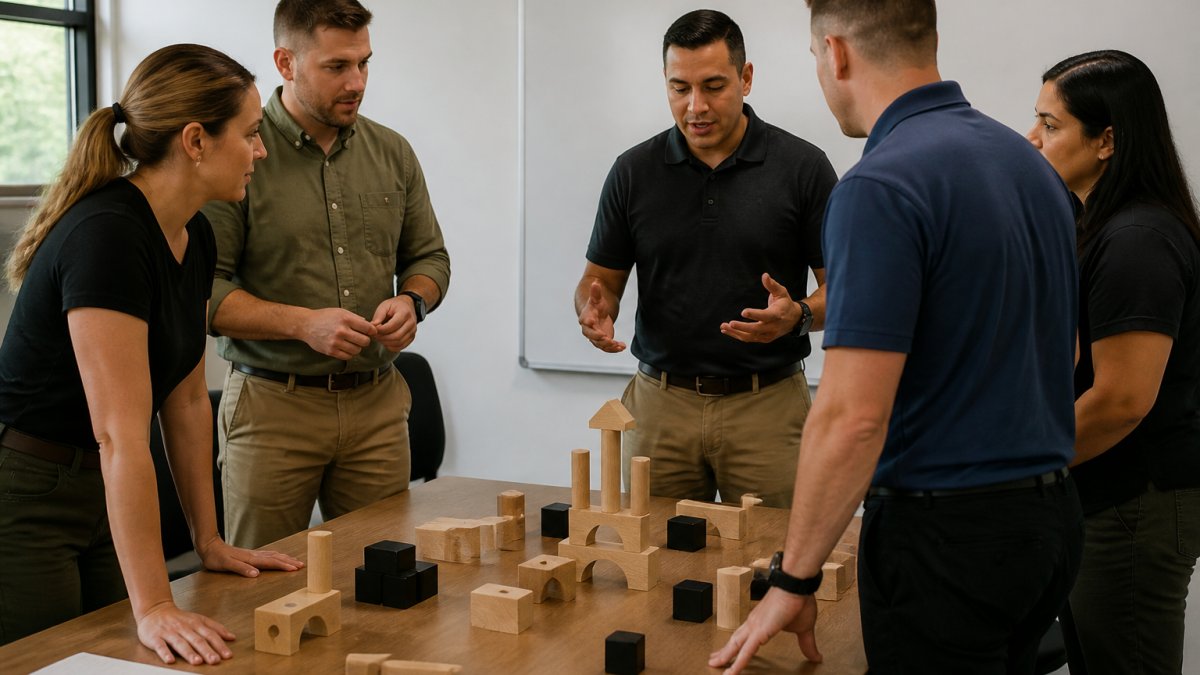
The Blindfold Build, isolates vague instructions.
One person sees a simple structure (blocks, cards, a drawn diagram) and gives verbal instructions only. Everyone else is blindfolded and builds. No pointing, no showing, no peeking.
The Two-Minute Brief, isolates missing confirmation.
One team member explains a task in two minutes flat. The listener repeats it back without notes. Any gap between the two versions is the lesson.
The Silent Handoff, isolates silent assumptions.
Two people pass a piece of work (a draft, a spreadsheet, a plan) back and forth three times. No talking. Each pass, the receiver writes one sentence about what they think they received. Compare the three sentences at the end.
The Debrief Is Where the Learning Happens
An exercise without a debrief is entertainment. Budget at least as much time for the debrief as for the exercise itself, and run it in this order:
- What happened? Facts only. No blame, no interpretation.
- Where did the information break down? Point to the specific moment, not the person.
- What would you do differently next time? Each participant answers for themselves.
- What’s the one habit we take back to work this week? Write it on the board. One habit, not five.
Transfer the Lesson Back to Real Work
The exercise only pays off if it changes Monday. Three mechanisms make that happen:
- Name the habit out loud. After the debrief, agree on a short phrase the team will use in real meetings, for example, “paraphrase check” or “two-minute brief.” A shared phrase is a shared trigger.
- Assign an owner. One person is responsible for running the exercise again in two weeks and reporting whether the habit showed up in real work.
- Tie it to a metric. If the Blindfold Build exposed vague instructions, watch your rework rate for the next month (see Step 6). If the Two-Minute Brief exposed missing confirmation, watch handoff errors.
A Simple 30-Day Rollout
You do not need a retreat. You need four weeks and thirty minutes a week.
- Week 1: Run the Blindfold Build. Debrief. Pick one habit.
- Week 2: Run the Two-Minute Brief on a live task. Debrief. Check whether the Week 1 habit appeared in real meetings.
- Week 3: Run the Silent Handoff on a real deliverable. Debrief. Review the metric you chose.
- Week 4: No new exercise. Review the month. Which habit stuck? Which didn’t? Decide what to keep and what to drop.
This is where structured pressure training pays off. Echo Sierra Tactical builds team communication under stress using realistic training cells and optional live opposition forces. Teams learn to share information fast when it matters, then carry those habits back to the office.
Rotate who runs the exercise each week. When the same person always facilitates, the team learns to communicate well for that person, not for each other.
Step 5: Give and Receive Constructive Feedback Without Defensiveness
Constructive feedback is specific, timely, and focused on behavior, not character. “You interrupted twice in that meeting” beats “you’re rude.” That much every guide says. What most guides skip is the language, the actual words to use, and what to do when the conversation goes sideways.
Scripts You Can Use Tomorrow
Vague advice fails under pressure. Concrete phrasing survives it. Adapt these to your own voice.
Raising a concern without sounding like a blocker:
“I want to flag a risk while it’s still cheap to fix.
Repairing a misunderstanding after the fact:
“I think we walked away from that meeting with two different pictures.
Giving feedback to a peer:
“I noticed the status update went out after the standup two weeks running.
Receiving feedback without defending:
“Let me make sure I have it. You’re saying the brief was clear but the timeline wasn’t.
The Four-Part Feedback Frame
Use this structure for any feedback conversation, positive or corrective:
- Observation, what you saw, with a time and place. No adjectives.
- Impact, the effect on the work, the team, or the customer.
- Request, the specific change you’re asking for next time.
- Check-in, a date to revisit whether it stuck.
What most guides miss is step four. Feedback without a follow-up two weeks later rarely changes anything. Put the check-in on the calendar before you leave the room.
When Feedback Goes Bad: Repair Steps
Defensiveness is normal. The skill is what happens next.
- If the receiver gets heated: pause the conversation. Say, “Let’s pick this up tomorrow morning.” Do not push through.
- If you (the giver) get it wrong: name it. “I came in hotter than I meant to. Let me restate it.” Repairing your own misstep builds more trust than a perfect delivery would.
- If the two of you still disagree: move to a shared artifact. Write the two versions of the expectation side by side on a doc. The written gap is usually smaller than the spoken one.
- If a pattern repeats: stop treating it as a feedback issue and treat it as a process issue. Recurring missed handoffs are usually an ownership problem, not an attitude problem.
Build the Safety to Receive It
Feedback only lands where people feel safe enough to hear it. Two habits build that safety faster than any workshop:
- Leaders go first. When a manager names their own recent mistake in a team meeting, everyone else’s threshold for honesty drops.
- Separate the roles. In any feedback conversation, one person describes what happened, the other listens fully before responding. No rebuttals mid-sentence.
Feedback lands best when it is about the work, not the person, and when both sides know what happens next. Keep it specific, keep it soon, script the hard parts, and always close the loop with a scheduled check-in.
Step 6: Measure Progress With Communication KPIs
You can measure team communication. Pick a few practical KPIs and track them monthly.
- Rework rate: How often tasks get redone due to unclear briefs
- Response time: How fast people answer priority messages
- Meeting load: Hours per week spent in meetings
- Handoff errors: Mistakes at the point where work changes hands
Track these for 90 days. If rework drops and handoffs get cleaner, your communication is improving. If not, go back to Step 1 and re-audit.
Step 7: Invest in Communication Skills Training for Teams
Communication skills training for teams works best when it is hands-on, not a lecture. People forget slides. They remember doing the work.
Look for training that:
- Puts the team under realistic pressure
- Forces fast information sharing
- Debriefs every exercise honestly
- Builds habits you can repeat at work
This is exactly what Echo Sierra Tactical delivers. Our veteran-founded facility in Charlotte runs immersive tactical escape rooms and realistic training cells. Teams face timed problems, make decisions under stress, and learn to communicate when it counts. Nearly a century of combined military service and 20+ combat deployments shape every exercise we run.
Frequently Asked Questions
How can managers encourage open communication on a team?
Managers set the tone by asking for input before giving direction and by responding to bad news without blame. Two habits move the needle fastest: hold short one-on-one meetings where the default question is ‘What is getting in your way?’, and publicly thank the person who raises a problem first. When people see that speaking up does not backfire, team communication shifts from guarded to open within a few weeks.
What are practical team communication exercises for improving skills?
Choose exercises that force clear instructions and fast feedback. The Blindfold Build has one person describe how to assemble an object while teammates build it without seeing the model, which exposes vague language immediately. The Two-Minute Brief asks each member to summarize a project status in two minutes with no notes. Run either exercise for 15 minutes, then debrief on what caused confusion. Repeat monthly so the lessons carry into daily work.
How can a team reduce misunderstandings and communicate more clearly?
Adopt a close-the-loop habit: after any verbal handoff, the receiver repeats the task, deadline, and owner back in one sentence. Write down decisions in a shared channel the same day, and label who owns each item. For remote or hybrid teams, default to written summaries after calls. These steps cut rework because everyone confirms the same version of the plan before work starts.
How long does it take to see real improvement in team communication?
Most teams notice fewer repeated questions and shorter meetings within four to six weeks of consistent practice. Lasting change takes about a quarter of regular reinforcement: weekly one-on-one meetings, monthly communication exercises, and tracking two or three simple KPIs such as missed handoffs or meeting overruns.
Team communication breaks down the moment pressure hits, and no slide deck fixes that. Echo Sierra Tactical builds communication, critical thinking, and teamwork through immersive tactical escape rooms, realistic training cells, and optional live opposition forces. Our veteran-led team helps your people perform under pressure, then carry those habits back to work. Book a mission with Echo Sierra Tactical and see how your team communicates when it matters.